
Why Taking a Proper Break Is Good for Business (Not Just Good for You)

Updated: Aug 26

When you're self-employed, there's no manager telling you to go and have your lunch, no colleague dragging you away from your desk for a coffee, and no fixed clocking-off time. That freedom is exactly why so many of us chose this path; but it also means the responsibility for protecting your own downtime sits entirely with you, and it's a responsibility that's remarkably easy to neglect.
If you've ever eaten a sandwich one-handed while replying to an email, or realised at 3pm that you haven't stood up since 9am, this one's for you.
The self-employed break problem
Research from Markel Direct, which surveyed 1,000 UK small business owners and sole traders, found that nearly half of UK small business owners and sole traders have considered quitting due to stress, with more than half reporting symptoms of burnout1.
A big part of the problem is the “always on” culture that self-employment can quietly encourage: the same research found that 57% regularly work beyond standard hours and 40% face out-of-hours client expectations, and without the boundaries of a structured working day, this constant perceived availability reduces downtime and limits opportunities to properly recharge.
I
t's not just about hours worked, either. The same study found that 44% of respondents are sleeping less than the recommended amount, and 6 in 10 skip medical appointments or exercise because of work.
A separate survey by Simply Business found that three quarters of small business owners take fewer than 20 days off work a year, and more than a third say they wouldn't take time off even if they were experiencing poor mental health, despite recognising it would help them2.
Regional research from the same Markel study also found the East Midlands sitting close to the top of the UK's burnout league table, with half of self-employed workers in the region reporting they've experienced burnout while running their own business, and a common theme across all UK regions being the pressure of staying “always-on,” with 52% of respondents finding it difficult to switch off at the end of the day3.
The good news buried in all this: it doesn't have to be this way, and the fix costs nothing except the discipline to actually step away.
The case for a proper lunch break
“Proper” is doing a lot of work in that sentence. Eating a sandwich over the keyboard while you carry on typing doesn't count; that's just multitasking with crumbs.
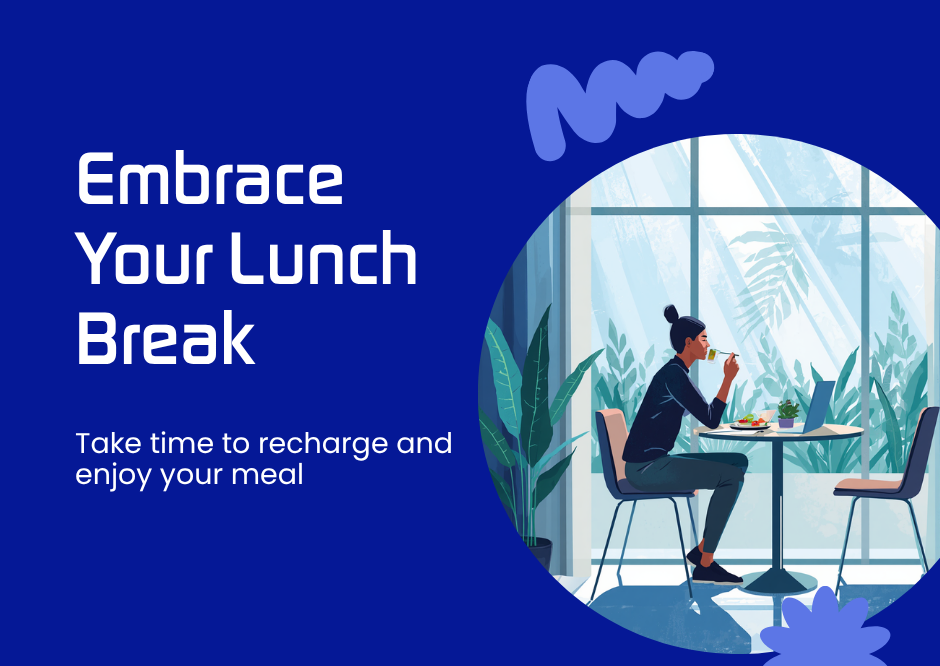
The evidence for stepping away is consistent and comes from multiple independent studies. ezCater's Lunch Report found that 94% of employees say a lunch break boosts their performance, with 85% saying their afternoon productivity improves after lunch, and more than half reporting greater mental clarity as a result4.
A separate Sharebite/Wakefield Research survey of office professionals found that 97% say taking a lunch break improves their workday5, with 51% agreeing that lunch breaks help them focus on work and be more productive, and 28% saying it makes them more creative.
Tork's well-known workplace survey backs this up from a slightly different angle, finding that 94% of respondents said stepping away from a task helps them get a fresh perspective on it, and 91% of employees agreed that taking a break helps them maintain mental focus6.
There's also a biological reason breaks matter more than we tend to assume. As ezCater's chief people and culture officer put it, working for more than 90 minutes without a break can lead to mental burnout, because our brains use a lot of energy to focus and need rest in between sprints to work effectively. If you're the kind of person who ploughs through the whole morning on caffeine and willpower, that's worth sitting with for a moment.
It's worth noting, too, that UK workers already take shorter lunch breaks than most: research from Eurest7 found that UK workers today take less than 33 minutes daily for their main lunch break, and many skip one lunch break entirely across the average five-day week. As a sole trader, there's nobody enforcing even that.
Dr Katie Barge, a chartered psychologist quoted in the Markel Direct research, recommends a simple structural fix: establishing fixed working hours and protecting them, taking structured breaks throughout the day to prevent cognitive overload, and making sure you don't skip lunch, aiming to include other 10 to 15 minute breaks either side too, even if it's just to grab a hot drink.
What to actually do with your break
A break spent scrolling work email on your phone, or catching up on invoicing “just while I eat,” isn't really a break at all; your brain never gets the chance to properly disengage. Here's what the research suggests genuinely helps.

Get away from your desk, and ideally outside.
This is the single biggest lever. Attention Restoration Theory8, developed by researchers Rachel and Stephen Kaplan, explains why: focused work depletes something called directed attention, and not all rest is restorative; the type of mental activity during a break determines whether directed attention actually recovers.
Natural environments are particularly effective at this because they engage the mind gently rather than demanding more focus. Research published in Frontiers in Psychology found that natural environments allow a parasympathetic response that restores mental energy and cognitive capacities9, and a randomised controlled trial published in Scientific Reports found that a nature walk placed measurably lower demands on executive attention than an equivalent walk through an urban environment. If you can't get outside, even a window with natural light, desk plants, or nature-scene imagery provides more restoration than staying at the desk8.
Actually eat away from your workspace.
UCLA's workplace wellness guidance10 is blunt about this one: avoid eating at your desk, since stepping away from your workspace helps you relax and clear your mind, and even a 15 to 20 minute lunch break has been shown to keep concentration and energy up during the day.
Move your body, even briefly.
You don't need a full workout. A short walk, some stretching, or simply standing up and moving around counters the effects of prolonged sitting and supports the same cognitive recovery as the outdoor breaks above.
Give yourself permission to switch off completely.
This is the one self-employed people tend to find hardest, precisely because there's no one else to hand things over to. As one accountancy firm put it plainly: would you expect an employee to work non-stop without breaks? No, so why hold yourself to a different standard? Treat your break the way you would if you were still an employee, and protect it the same way you'd protect a client deadline.
Batch your admin instead of drip-feeding it through the day.
If invoicing, compliance paperwork, or bookkeeping is the thing that keeps nibbling at your breaks “because it'll only take five minutes,” set it aside for a dedicated slot instead. It stops your downtime being quietly eaten alive by small tasks, one interruption at a time.
The business case, not just the wellbeing case
None of this is really a “treat yourself” argument. The research above points to something more useful for anyone running their own business: breaks are a productivity tool, not a productivity cost. The Health and Safety Executive's most recent figures show that work-related stress, depression, and anxiety accounted for 964,000 cases in Great Britain in 2024/25, contributing to an estimated 40.1 million working days lost across the year11.
The CIPD's own research points the same way, finding that supportive, well-managed working practices directly benefit employee wellbeing, performance, and productivity, while unhealthy ways of working are strongly linked to excessive workloads and pressure12. As a sole trader, you are your own HR department, so it falls to you to build the same protections in.
If you wouldn't run a piece of equipment flat out with no downtime for maintenance, it's worth asking why you'd do the same to yourself; you're the single most important asset in your business, and unlike most equipment, you can't simply be replaced while you recover.
So, tomorrow, close the laptop lid at lunchtime. Put the phone in another room.
Go for a walk, even a short one. Your afternoon self will thank you, and so, probably, will your business.
Sarah runs Smallbizbod, providing bookkeeping, compliance, and business administration support to sole traders and small businesses, and The Bid Zone, helping small businesses win public sector contracts. If keeping on top of your business admin is one of the things eating into your breaks, get in touch to find out how she can help.
Sources
1. PHAM News – Self-employed workers at risk of burnout — https://phamnews.co.uk/self-employed-workers-at-risk-of-burnout/
2. Simply Business – Self-employed burnout and sleep deprivation — https://www.simplybusiness.co.uk/knowledge/wellbeing/self-employed-burnout-sleep-deprivation/
3. Grantham Matters – Half of self-employed workers in the East Midlands have experienced burnout — https://granthammatters.co.uk/half-of-self-employed-workers-in-the-east-midlands-have-experienced-burnout/
4. ezCater – The Lunch Report: the power of lunch breaks — https://www.ezcater.com/lunchrush/office/the-power-of-lunch-breaks/
5. Forbes – The key to workplace productivity isn't late nights, it's lunch — https://www.forbes.com/councils/forbesbusinesscouncil/2023/01/03/the-key-to-workplace-productivity-isnt-late-nights-its-lunch/
6. Workforce.com – 5 surprising lunch break statistics in the US — https://www.workforce.com/news/5-lunch-break-statistics-that-shed-light-on-american-work-culture
7. Eurest – The power of the lunch break — https://eurest.co.uk/news-blog/the-power-of-the-lunch-break-latest-research-proves-their-importance/
8. Pomogolo – Attention Restoration Theory — https://pomogolo.com/blog/attention-restoration
9. NCBI – Walking and sitting outdoors: which is better for cognitive performance and mental states? — https://www.ncbi.nlm.nih.gov/pmc/articles/PMC9778927/
10. UCLA Recreation – Workplace wellness guidance — https://fitwell.recreation.ucla.edu/file/f4a90ce9-0259-49bb-b9a1-bc8cd9e8c8de
11. HSE – Health and safety statistics overview — https://www.hse.gov.uk/statistics/overview.htm
12. CIPD / People Management – Good Work Index 2025 — https://www.peoplemanagement.co.uk/article/1921073/quarter-employees-say-work-negative-impact-mental-physical-health-cipd-research-reveals


Comments