
Bookkeeping Basics for Sole Traders

Updated: Aug 10

Let's start with something nobody really tells you when you first go self-employed: the business side of running a business is a full-time job in itself. You're brilliant at what you do. That's why you went out on your own. But between the invoices, the receipts, the expenses, and the looming deadline of a self-assessment tax return, the financial admin can feel like a permanent pile of washing that never quite gets done.
The good news is that bookkeeping doesn't have to be complicated. For most sole traders, it comes down to a handful of habits, done consistently, that keep HMRC satisfied and give you a clear picture of where your money actually is. Here's what you need to know.
What Records Do You Actually Need to Keep?
HMRC requires self-employed individuals to keep records of all income and expenses relating to their business. That sounds obvious, but the detail matters. You need to keep:
Records of all sales and income (invoices, receipts, bank statements)
Records of all business expenses (what you bought, what it was for, proof of purchase)
Bank statements and any business accounts
Records of any goods or stock if your business involves physical products
VAT records if you're VAT-registered
HMRC expects you to keep these records for at least five years after the self-assessment deadline for the relevant tax year (or six years if you are VAT registered). So, for the 2024/25 tax year (deadline January 2026), your records need to be kept until at least January 2031. Don’t bin anything early!
What Counts as a Business Expense?
This is the question I get asked most often, and understandably so; it's the area where sole traders either miss out on legitimate deductions or accidentally claim things they shouldn't. Broadly speaking, a business expense is something that is wholly and exclusively for the purpose of your business. HMRC doesn't love grey areas, but some common allowable expenses include:
Office costs (stationery, postage, software subscriptions)
Travel costs for business purposes (not your commute if you have a fixed place of work, but client visits, site visits, and similar)
Clothing that is a uniform or protective gear required for your work
Marketing costs (your website, advertising, business cards)
Professional fees (accountants, bookkeepers, legal costs)
Training directly related to your current business activities
If you work from home, you can also claim a proportion of household costs. How you calculate this depends on whether you use the simplified expenses method or work out the actual costs. Both are valid; you just need to be consistent and be able to evidence your figures.
If you're ever unsure whether something qualifies, the HMRC guidance at gov.uk is a reasonable starting point. Alternatively, speak to a bookkeeper before you claim it, not after.
The Self-Assessment Deadline: Don't Be That Person
The self-assessment tax year runs from 6 April to 5 April. You then have until 31 January the following year to file your return online and pay any tax owed. So, for the tax year ending 5 April 2025, the deadline is 31 January 2026. Miss that deadline, and you'll get an automatic £100 penalty, even if you don't owe any tax. Miss it by three months, and daily penalties kick in. It escalates from there.
The single most effective thing you can do to avoid stress around self-assessment is to not leave everything until January. If you're keeping your records up to date throughout the year, the return itself becomes a relatively straightforward exercise. If you're trying to reconstruct twelve months of transactions from memory and a biscuit tin full of receipts, it's a very different experience.
Cash Basis vs. Traditional Accounting: Which One Are You Using?
This is one of those things that often catches sole traders off guard. There are two ways to account for your income and expenses:
Cash basis: You record income when you receive it and expenses when you pay them. This is simpler and is the default method for most sole traders with an income under £150,000.
Traditional (accrual) accounting: You record income when it's earned and expenses when they're incurred, regardless of when the money actually moves. This is more complex but gives a more accurate picture of your financial position at any given point.
Most sole traders use cash basis without realising that's what it's called. That's fine; it works well for straightforward businesses. The important thing is to know which method you're using and to apply it consistently.
Practical Habits That Make This a Lot Less Painful
You don't need expensive software or an accountancy degree to stay on top of your bookkeeping. What you do need is consistency. Here are a few habits that make a real difference:
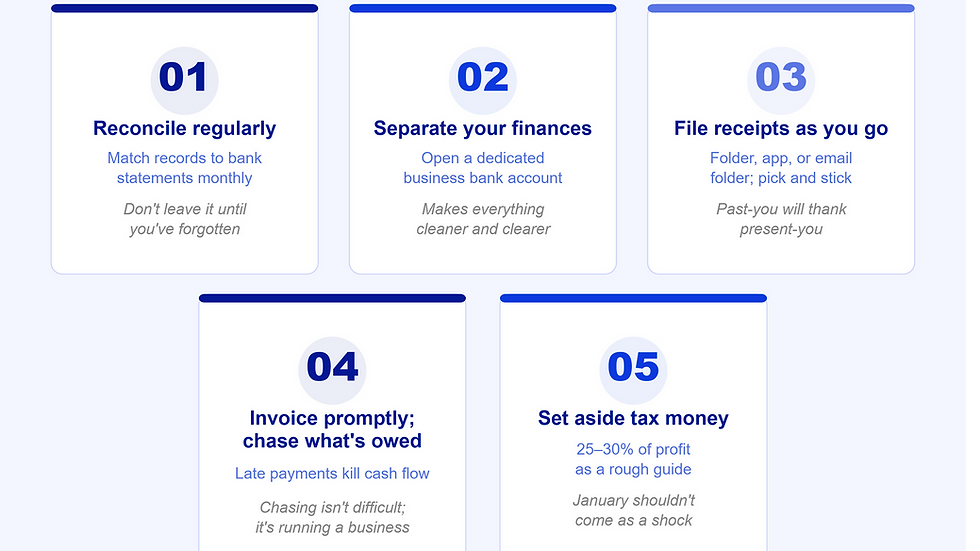
Reconcile regularly: Match your records to your bank statements at least monthly. If you leave it longer, you'll forget what transactions were for.
Keep business and personal finances separate: Open a separate bank account for your business, even if you're a sole trader with no legal obligation to do so. It makes everything cleaner and easier to track.
File receipts as you go: Whether that's a folder on your desk, a phone app, or a dedicated email folder for digital receipts; find a system and stick to it.
Invoice promptly and track what's outstanding: Late payments are a cash flow killer. Know what you're owed and chase it. That's not being difficult; it's running a business.
Set money aside for your tax bill: A common rule of thumb is to put 25-30% of your profit aside for tax and National Insurance. The exact figure will depend on your circumstances, but not budgeting for it at all is how people end up in January with a bill they can't pay.
Do You Need to Register for VAT?
You only need to register for VAT if your taxable turnover exceeds the VAT threshold (currently £90,000 in a rolling twelve-month period). If you're under that threshold, VAT registration is optional; you can register voluntarily if it makes commercial sense for your business, but you're not obliged to.
If you are VAT-registered, your bookkeeping becomes more involved. You'll need to track input and output VAT separately, file VAT returns (usually quarterly), and submit them via Making Tax Digital-compatible software. That's a topic in its own right, but the key point is: don't ignore the threshold. If you're approaching it, get ahead of it rather than scrambling to register when you've already crossed it.
The Bottom Line
Bookkeeping as a sole trader isn't glamorous. It's not why you started your business. But done consistently, it protects you, keeps you compliant, and gives you actual visibility of whether your business is making money.
The goal isn't to become an accountant. The goal is to know where you stand, have the records to prove it, and never have to dread an HMRC letter because you know everything is in order.
If that all sounds straightforward in theory but you keep putting it off in practice, that's exactly the kind of thing I help with at Smallbizbod®. From getting your records in order to managing the ongoing admin so you can focus on doing what you're actually good at, I've got the back-office side covered.
Get in touch at www.smallbizbod.com/contact-us if you'd like to find out more.


Comments